Wiring, Outlets and Remodels
Heat tape and roof de-icing circuits for Grand Rapids winters
Heat cable works only when it has a proper circuit behind it: ground-fault protection, a control that turns it on when it is needed, and a receptacle that is not an extension cord through a window. We wire roof, gutter and pipe heat cable so it runs safely every winter.
Updated September 2026
- Answered 24/7
- Ground-fault protected
- Controls and sensors
- Roof, gutter and pipe cable
Quick answer
Heat tape and roof de-icing circuits in Grand Rapids supply roof, gutter and pipe heat cable through a dedicated, ground-fault protected circuit with a weather-rated receptacle or junction box and a controller that switches the cable on by temperature or moisture. Proper circuits prevent overloaded outdoor outlets, tripping and cable damage.
What this job is
The cable is only as good as the circuit
Most heat cable problems are electrical, not the cable itself: long runs plugged into a shared porch outlet that trips, cable left on all winter because nothing switches it off, and damaged cable on a circuit with no ground-fault protection. We size the circuit to the total cable length, add the protection the manufacturer and code require, and fit a control so the cable runs only when there is ice to melt.
What you notice first
Signs your heat cable setup needs work
Outdoor outlet trips in cold snaps
Too much cable on one circuit or a fault.
Extension cord to the roof cable
Not rated for continuous outdoor load.
Ice dams despite cable
Wrong layout or cable not running.
Cable on all winter
No control, so high bills.
Frozen pipes with tape installed
Failed tape or tripped protection.
Scorched or crushed cable
Damage that can start a fault.
The versions of this job
Roof and gutter de-icing cable
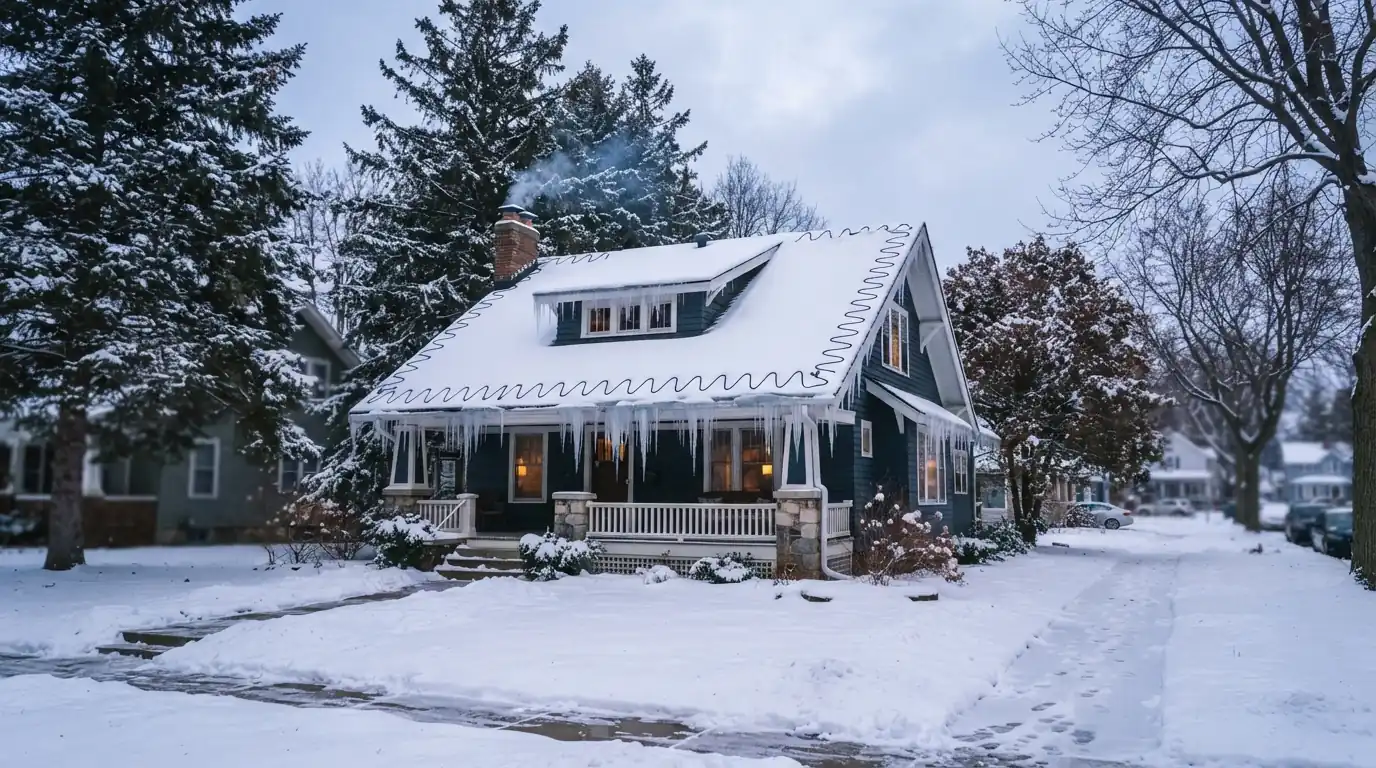
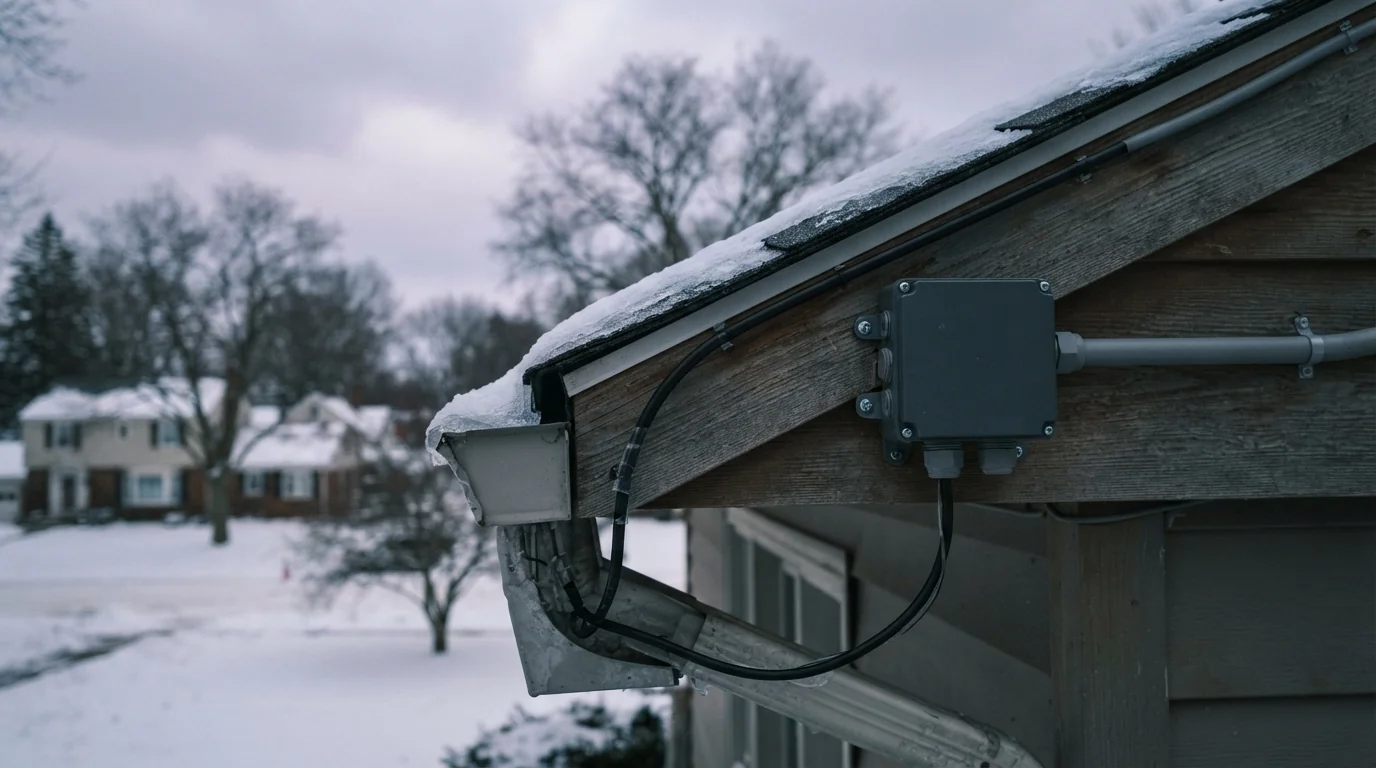
Roof cable is laid in a zig-zag along the eaves and run through gutters and downspouts so meltwater has a clear path off the roof. The electrical side is a dedicated circuit sized to the total cable length, fed to a weather-rated junction box or receptacle near the roofline, with ground-fault equipment protection. We plan the feed point so the cable does not have to snake across the roof to reach power, and keep connections out of the path of sliding snow and ice.
Pipe heat tape circuits
Pipes in crawl spaces, exterior walls, garages and well houses freeze first in a cold snap. Heat tape keeps them above freezing, but only if it has power it can rely on and protection that works. We provide a protected receptacle or hardwired feed near the pipes, check the tape type against the pipe material, and make sure the circuit is not shared with anything that trips often. Plastic pipes need tape rated for them, which is easy to get wrong.
Controllers and sensors
A cable that runs all winter wastes power and wears out sooner. An ambient thermostat switches it on below a set temperature; a snow and moisture sensor switches it on only when there is precipitation to melt, which cuts running time significantly. We wire the controller, set it for the application, and show you how to check that it is working, so the cable is on during an ice storm and off during a dry cold spell when there is nothing on the roof to melt.
GFCI protection for heat cable
Heat cable lives in wet, icy places and can be damaged by shoveling, ice and wildlife, so ground-fault protection is required. Many products call for equipment ground-fault protection rather than a standard receptacle GFCI, so the circuit protection is matched to the cable. We test it after installation and show you the test, because a protection device that has been quietly tripped for weeks is a common reason ice dams come back. We label the device and its test schedule at the panel.
Local conditions
Local conditions that change the work
Grand Rapids averages about 73 inches of snow a season, and the long-term average rose from 70.9 inches for 1961-1990 to 76.9 inches for 1991-2020, with most of the increase in January and February. Those deep-winter months are when ice dams form and pipes freeze, so heat cable here has to work reliably from December through March, every single winter.
Cost factors
What moves the price on this job
Cable length, the circuit and the control decide the price.
Typical regional ranges: outlet installation $120 to $350 and electrician labor $75 to $150 per hour, as planning figures rather than our price.
- 01
Total cable length
Longer runs need larger circuits.
- 02
Distance to the feed point
Roofline feeds can mean long runs.
- 03
Control type
Sensors cost more than thermostats.
- 04
Protection device
Equipment ground-fault protection.
- 05
Roof access
Steep or tall roofs take more time.
- 06
Pipe locations
Crawl spaces and well houses.
- 07
Permit
New circuits are permitted and inspected.
Choosing between them
Which cable and control fits
| Choice | Best for | Trade-off |
|---|---|---|
| Self-regulating cable | Roofs, gutters and pipes | Costs more per foot, safer to overlap |
| Constant-wattage cable | Short, simple pipe runs | Must never overlap itself |
| Ambient thermostat control | Pipes and simple roof runs | Runs whenever it is cold |
| Snow and moisture sensor control | Larger roof and gutter systems | Higher upfront cost, lower bills |
How the job runs
How a heat cable circuit job runs
Walk the problem areas
Eaves, gutters, valleys and pipes.
Total the cable load
Length and wattage per foot.
Plan the feed and circuit
Dedicated, protected, sized.
Install feed and control
Junction box, receptacle, sensor.
Connect and test
Protection tested, cable warms.
Show you the checks
Test button and controller settings.
Straight answers
Questions about heat tape and roof de-icing circuits in Grand Rapids
Still unsure? Call (616) 699-4794 and ask a technician.
Only if the circuit can carry the cable load and has the right protection; many cannot.
Yes. Many products require equipment ground-fault protection.
No. A thermostat or snow sensor saves power and extends cable life.
Too much cable on one circuit or a damaged section; it needs testing.
Only tape rated for plastic pipe, installed to the maker's instructions.
Same category