Inspections and Commercial
Temporary construction power for builds and remodels around Grand Rapids
Every build needs power long before the house has a panel. We set the temporary service, coordinate with the utility and the inspector, provide the jobsite outlets the trades need, and take it all down once permanent service is energized, so the schedule is not waiting on electricity.
Updated September 2026
- Answered 24/7
- Temporary service poles
- GFCI-protected jobsite outlets
- Utility and inspection coordination
Quick answer
Temporary construction power near Grand Rapids means installing a temporary service, usually a pole or pedestal with a meter socket and GFCI-protected outlets, getting it inspected so the utility can connect it, supplying the circuits the trades and any well pump need during the build, and removing it once the permanent service is energized.
What this job is
Power from the first day on site
Framers, plumbers and the drywall crew all need power from day one, and running everything from a generator is noisy, costly and fragile. A temporary service gives the site real outlets on a metered connection. It has to be built to code, inspected and released to the utility before it is connected, which is where builders lose days if nobody is managing it.
When the house is ready, we wire and energize the permanent service or standard 200-amp service and remove the temporary equipment in the same sequence, so there is no gap in power on site.
Cost factors
What moves the price on this job
The type of temporary service and how long the build runs decide most of the cost.
Electrical permits run about $50 to $300 in regional cost guides; this is a planning figure, not our price.
- 01
Pole or pedestal
A new pole costs more than a pedestal on an existing feed.
- 02
Distance to the utility
Longer runs to the source add material.
- 03
Number of outlets
Larger sites need more circuits.
- 04
Well pump power
Rural lots may need a well circuit.
- 05
Build length
Long builds may need return visits.
- 06
Permit and inspection
Required before connection.
- 07
Changeover
Moving circuits to permanent power at the end.
What is included
What temporary power covers
- Temporary pole or pedestal with meter socket
- Main breaker and GFCI-protected outlets
- Grounding at the temporary service
- Permit and inspection for utility release
- Utility coordination for the connection
- Circuits for well pumps or heaters during the build
- Changeover to permanent service
- Removal of temporary equipment
- Return visits for added circuits
Choosing between them
Temporary power options
| Option | Good for | Trade-off |
|---|---|---|
| Temporary service pole | New homes and larger builds | Needs utility connection and inspection |
| Power from the existing house | Additions and remodels | Only where the existing service has capacity |
| Portable generator | Very short tasks | Noise, fuel and limited capacity |
The versions of this job
Temporary service poles
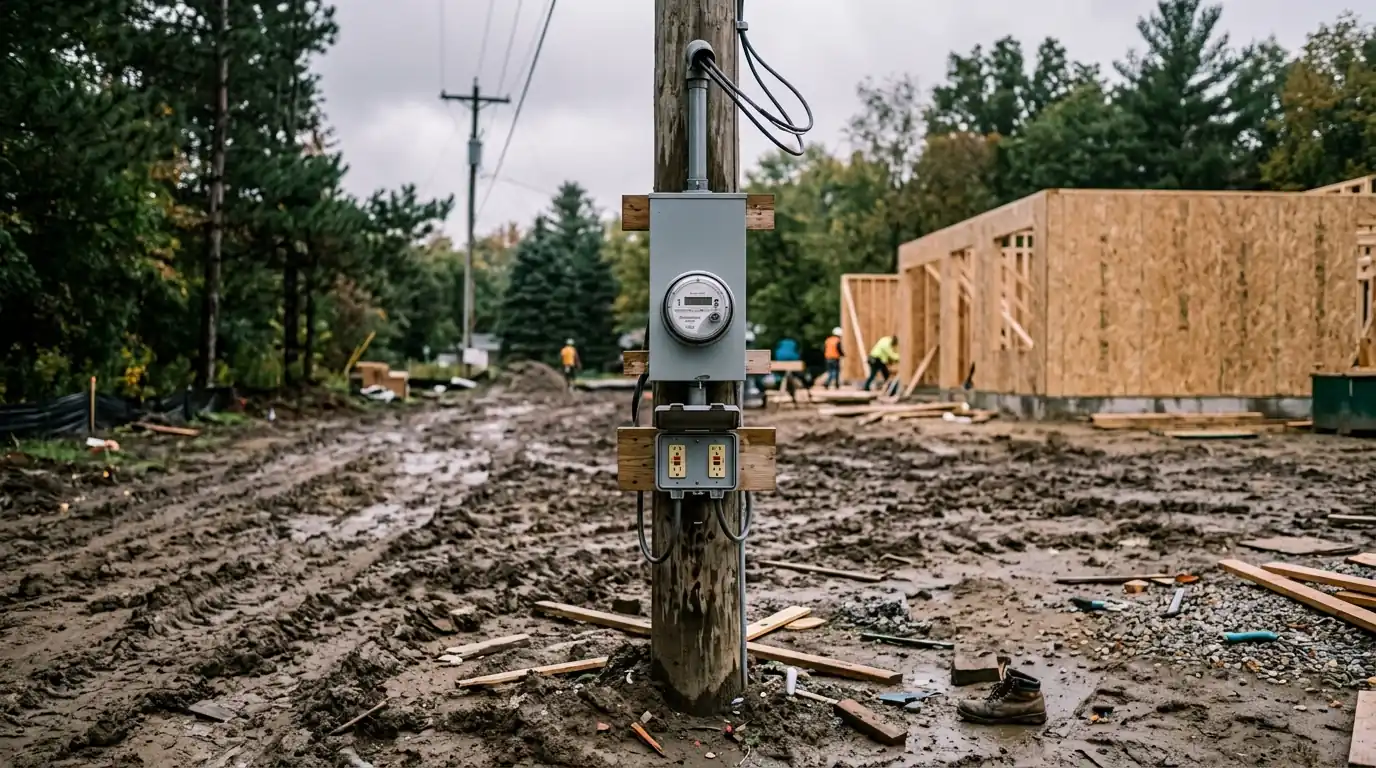
A temporary service is a small, complete electrical service on a pole or pedestal: a meter socket, a main breaker, grounding and a set of weatherproof, GFCI-protected outlets. We build it to the utility's specifications and the code, place it where the trades can reach it without running cords across the driveway, and get it inspected. Once the inspection is approved, the utility can set the meter and energize it. Planning this early is what keeps a new build from waiting a week for power.
Jobsite outlets and safety
Construction sites are wet, muddy and full of extension cords, which is why every temporary outlet must be GFCI protected. We provide enough outlets and circuit capacity for saws, compressors and heaters running at the same time, so breakers are not tripping all day. We check the GFCI devices when we set up and can return to test them during a long build. A safe temporary setup protects the crews and keeps a single nuisance trip from stopping the whole site. Cords are kept off walkways where we can route them.
Remodels and additions
On a home addition or a large remodel, temporary power can sometimes come from the existing house through a dedicated circuit and a weatherproof outlet panel, which avoids a separate utility connection. That only works where the house service has capacity to spare. We check the load first, then set up protected outlets for the crews. If the house service cannot carry it, a temporary pole is the safer choice, and we will say so before the project starts. Any temporary outlet panel is removed once the work inside is finished.
Changeover to permanent service
Near the end of the build, the permanent service and panel are installed, inspected and released for connection. We coordinate the timing with the utility so the house is energized before the temporary service is removed, move any circuits that were running from the temporary panel, and take the pole or pedestal away. A clean changeover means the final trades, the HVAC start-up and the cleaning crew all have power without a single day lost. We also remove any temporary grounding rods and leave the lot clear for final grading and landscaping.
Local conditions
Local conditions that change the work
Kent County requires a permit to install an on-site water well, and rural townships east and north of Grand Rapids rely on private wells and septic systems. On those lots the well pump often needs power during construction for the trades and for testing, so we size the temporary service to run it as well as the tools. Well permits and inspections run on their own schedule, so the temporary service needs to be ready before the well contractor arrives.
How the job runs
How temporary power is set up
Site plan
Where the pole and outlets go.
Permit
Pulled before building the service.
Build the service
Meter socket, breaker, grounding, outlets.
Inspect and release
Inspection, then utility connection.
Support the build
Added circuits as trades need them.
Change over
Permanent power on, temporary removed.
Straight answers
Questions about temporary construction power in Grand Rapids
Still unsure? Call (616) 699-4794 and ask a technician.
It depends on the inspection and utility schedule, so start early.
Yes, temporary construction outlets must be GFCI protected.
Sometimes, if the existing service has capacity to spare.
We remove it after the permanent service is energized.
Yes, if the temporary service is sized for it.
Same category