Lighting and Fans
Outdoor and landscape lighting installed for Grand Rapids homes
Good outdoor lighting makes steps safe, shows off the house and makes the yard usable after dark without glaring at the neighbors. We plan it with you at dusk, run the circuits to handle Michigan winters, and put it on timers or photocells so it runs itself.
Updated September 2026
- Answered 24/7
- Low and line voltage
- GFCI-protected circuits
- Timers and photocells
Quick answer
Outdoor and landscape lighting in Grand Rapids usually means low-voltage path, garden and uplighting fed by a transformer, plus line-voltage fixtures on the house, deck and garage. Line-voltage work needs GFCI protection and a permit; low-voltage runs can be shallow-buried. Both are best laid out at dusk to see the effect.
What this job is
Light the path, the steps and the house, in that order
The best outdoor lighting starts with safety: steps, walks and doors. Then it lights the features worth seeing, such as a tree, a stone wall or the front of the house. Low-voltage systems handle most landscape work safely and flexibly, and fixtures can be moved as plantings grow. Line-voltage circuits feed wall lights, post lights and deck receptacles, and those need the heavier wiring the code sets for outdoor use.
Cost factors
What moves the price on this job
Fixture count, system type and cable runs drive the price.
Typical regional ranges: $120 to $350 for an outlet installation, as a planning figure rather than our price.
- 01
Number of fixtures
Each light adds a fixture and a connection.
- 02
Low or line voltage
Line voltage needs heavier wiring and a permit.
- 03
Transformer size
Larger systems need a larger transformer.
- 04
Cable runs
Longer and more complex runs take longer.
- 05
Surfaces
Boring under walks and drives adds labor.
- 06
Fixture quality
Brass and cast fixtures cost more.
- 07
Controls
Timers, photocells and smart controls.
Choosing between them
Low voltage or line voltage
| System | Best for | Trade-off |
|---|---|---|
| Low-voltage landscape | Paths, beds, trees, walls | Needs a transformer and planned runs |
| Line-voltage fixtures | Wall, post and garage lights | Permit and buried conduit or cable |
| Deck and step lighting | Stairs and railings after dark | Best planned before decking goes on |
The versions of this job
Low-voltage path lighting
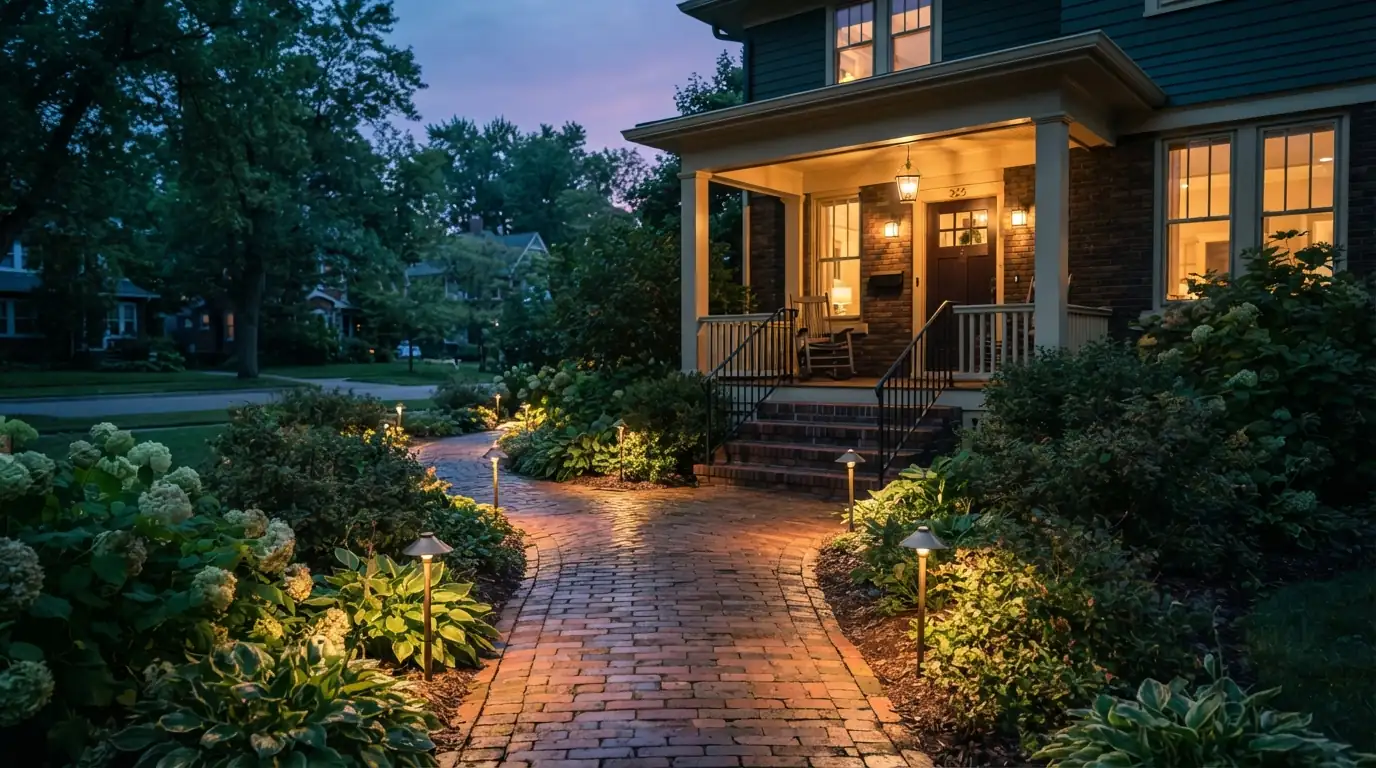
Path lights along walks and driveways turn a dark yard into something you can cross safely. A low-voltage transformer steps household power down to a safe level, and cable runs to each fixture just below the surface. We size the transformer with room to add lights later, keep runs balanced so the last fixture is as bright as the first, and set the spacing so pools of light overlap on the walk rather than making a runway of dots along it.
Deck and patio lighting
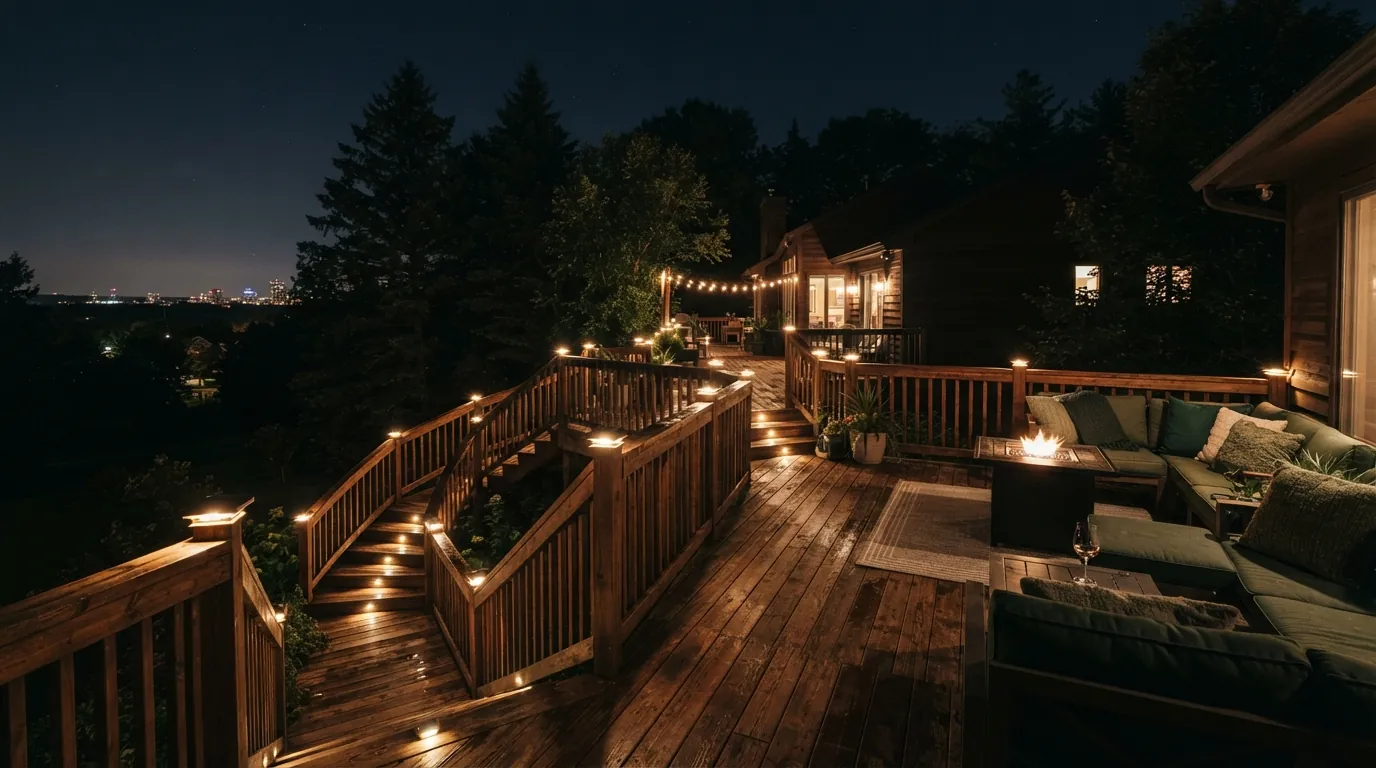
Step lights, railing lights and under-cap lights make a deck usable after dark and stop missed steps. On a new deck these are easiest to install before the boards go down; on an existing deck we route cable under the framing. Patios get wall lights on the house, a few well-placed downlights, and GFCI-protected weather-resistant receptacles with in-use covers for heaters, speakers and seasonal lights, so nothing runs through a window. Fixtures are chosen to throw light down onto the boards rather than into the eyes of people sitting on the deck.
Soffit and eave lighting
Downlights set into the soffit wash the front of the house evenly, light the entry and the driveway, and avoid glare in neighbors' windows. They need a clear bay in the soffit and a switched circuit, often from the attic. We space them to the rhythm of the windows and doors, choose a warm color temperature that suits the siding, and put them on a timer or smart switch so the house looks lived-in whenever you are away, even through the short days of a Michigan winter.
Exterior GFCI circuits
Outdoor receptacles and line-voltage fixtures need GFCI protection and weather-resistant, in-use covers. Buried line-voltage circuits need the right cable or conduit at the depth the code sets. We run circuits to where you actually use power outside, such as the patio, garden beds, the front for holiday lights, and the back fence, so nothing ends up on an extension cord through a door left ajar all season. Receptacles near grade are set high enough to stay clear of snow piled along the house.
Local conditions
How Grand Rapids homes shape this job
New construction across the northeast side of Grand Rapids often leaves the yard lighting for later, and it is easiest to add while landscaping is still going in. Michigan requires a permit before any electrical conductor is installed or altered, so line-voltage outdoor circuits are permitted and inspected; low-voltage runs from a plug-in transformer are simpler and can go in any time the ground is soft.
Before you call
What you can check yourself and what needs an electrician
| Situation | Safe to do yourself | Leave to us |
|---|---|---|
| Plug-in low-voltage kit | Place fixtures and shallow-bury the cable | Add an outdoor GFCI outlet for it |
| New post or wall light | Choose the fixture | Run the line-voltage circuit and box |
| Lights not coming on | Check the timer and photocell | Test the transformer and circuit |
How the job runs
How an outdoor lighting job runs
Walk the yard at dusk
Where light is needed and wanted.
Plan the layout
Fixtures, transformer and circuits.
Permit line-voltage work
Filed where required.
Install and bury
Fixtures, cable and connections.
Aim and adjust
At dark, fixture by fixture.
Set controls
Timer, photocell or smart switch.
Outdoor fixtures from Kichler and controls from Lutron and Leviton.
Straight answers
Questions about outdoor and landscape lighting in Grand Rapids
Still unsure? Call (616) 699-4794 and ask a technician.
Yes. It runs at a low voltage from a transformer and can be shallow-buried.
Line-voltage circuits do; plug-in low-voltage systems generally do not.
Usually, if the transformer has spare capacity; otherwise we add one.
Yes, with outdoor-rated fixtures, sealed connections and proper burial.
Yes. Timers, photocells or smart controls run them automatically.
Same category